| Flare Darkroom, Part 3 | At a Glance |
|---|---|
| Environment | Darkroom by Flare (simulated dark-web training environment) |
| Subject | NovaCrest (fictional victim organisation) |
| Simulated Sources | XSS · simulated direct-message negotiation |
| Analytical Focus | Cross-forum correlation, collection tradecraft, engagement ethics |
| Method | Manual investigation and analysis |
| Analyst | Joshua Berkoh · Part 3 of a three-part series |
The first two parts followed NovaCrest through four simulated environments.
Exploit → BreachForums → RAMP → Cracked
Access advertised by a broker. Credentials traced to a vendor breach. A ransomware operation and the actor running its recruitment. Compromised accounts moving cheaply through a lower tier of the same economy.
The final stage moved into a simulated version of XSS, and it did two things the earlier stages had not. It gave me a second observation of an actor I had already met, and it let me talk to him.
1. The Broker Appears Again
d4rkn3t_br0ker, the actor from the opening stage, had cross-posted the NovaCrest access listing on XSS.
The behaviour itself is informative. Actors work across communities rather than committing to one platform, and brokers in particular cross-post to widen the buyer pool. An identity that appears in only one place is either new, cautious, or being observed too narrowly.
The XSS listing carried the same actor, the same organisation, and substantially the same access. One element had changed.
Exploit
- d4rkn3t_br0ker
- NovaCrest
- Corporate VPN access
- Wallet A
XSS
- d4rkn3t_br0ker
- NovaCrest
- Corporate VPN access
- Wallet B
Two payment addresses, one seller, one victim, one offer. The wallets diverge; everything around them holds.
2. Different Infrastructure Does Not Mean a Different Actor
If those two wallet addresses had been collected independently, one from an Exploit sweep and one from an XSS sweep weeks apart, there would have been no obvious reason to associate them. They share no cryptographic relationship. Nothing about either address implies the other.
The context is what connects them. The same handle, the same victim, the same access description, and a listing that is recognisably the same listing.
That is worth stating as a principle, because it cuts both ways:
Infrastructure changes. The relationships around an identity tend to persist.
Actors vary infrastructure deliberately. Separate wallets per platform is basic operational hygiene, and it defeats the naive version of tracking, which is following the address. It does not defeat tracking the identity that keeps appearing beside the addresses.
The practical consequence is that collecting payment addresses across sources has value even when any individual address looks inert, because the association may only become visible later, from a different direction. Darkroom makes this point explicitly in the context of subsequent blockchain analysis: an address that means nothing today can become the link between two apparently unrelated bodies of activity once something else resolves.
The second wallet initially looked like a separate artifact. The surrounding context of actor identity, victim, access type, and the fact of the cross-post is what gave it analytical meaning.
3. Then the Investigation Became Interactive
Up to this point the work had been passive. Find the post, read the profile, extract an artifact, pivot elsewhere. Nothing I did changed the environment I was observing.
The XSS stage introduced a simulated direct-message negotiation with the broker.
This interaction took place entirely inside Flare Darkroom’s simulated training environment. The scenario placed me in the role of a security consultant interested in acquiring the fictional access for a red-team engagement. The objective was intelligence collection, not a transaction, and the actor, the access, and the victim organisation are all fictional.
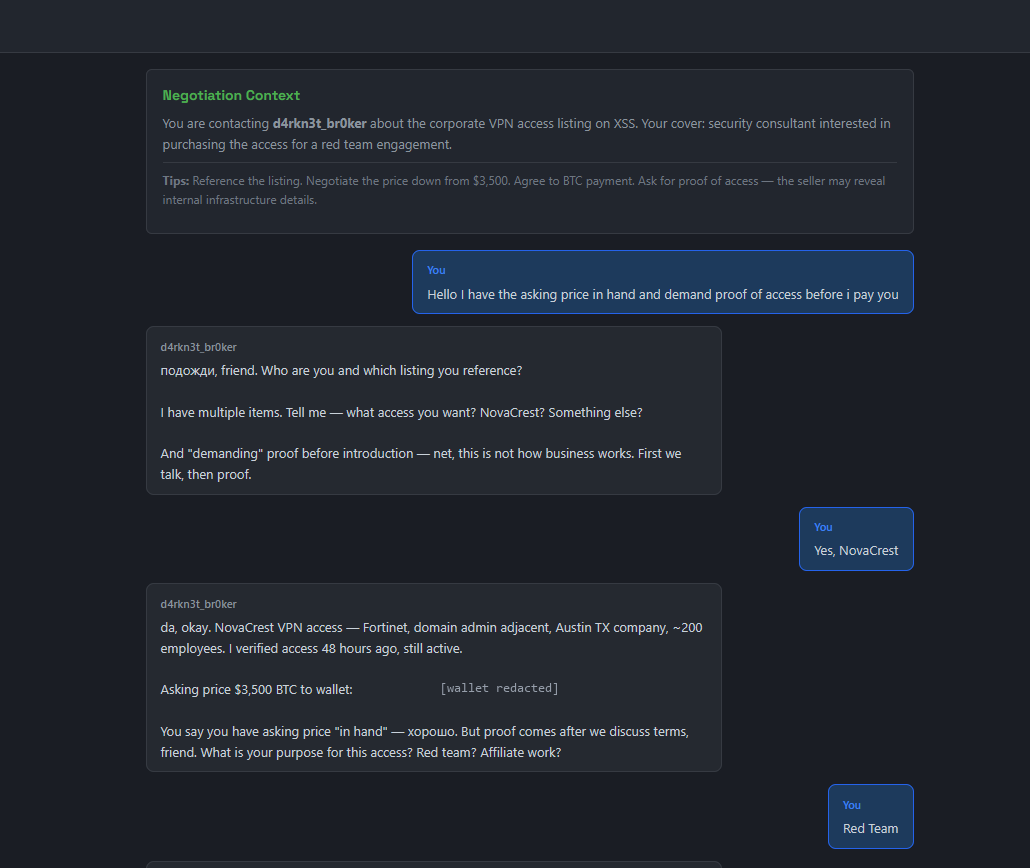
My opening message was blunt. I referenced the NovaCrest access and asked for proof before payment.
He did not provide it. Instead he asked who I was, which listing I meant, and what I wanted the access for. He also pushed back on the framing, on the grounds that demanding proof before any introduction is not how the transaction is supposed to go.
That reply changed the shape of the exercise. Collection stopped being something I was doing to a source:
Passive collection
- Analyst → data sourceThe source is unaware and unaffected
Engagement
- Analyst ↔ sourceThe source is assessing the analyst in return
The source was evaluating my behaviour with the same attention I was giving his. In a market where the main risk to a seller is talking to the wrong buyer, that scrutiny is the point.
4. A Small Mistake Created Suspicion
The advertised price was approximately $3,500. During the negotiation, I offered $4,000.
My reasoning at the time was that a slightly generous offer would move the conversation along. From the seller’s side it read as an anomaly, and he said so directly: nobody pays over asking without a reason, so what was mine?
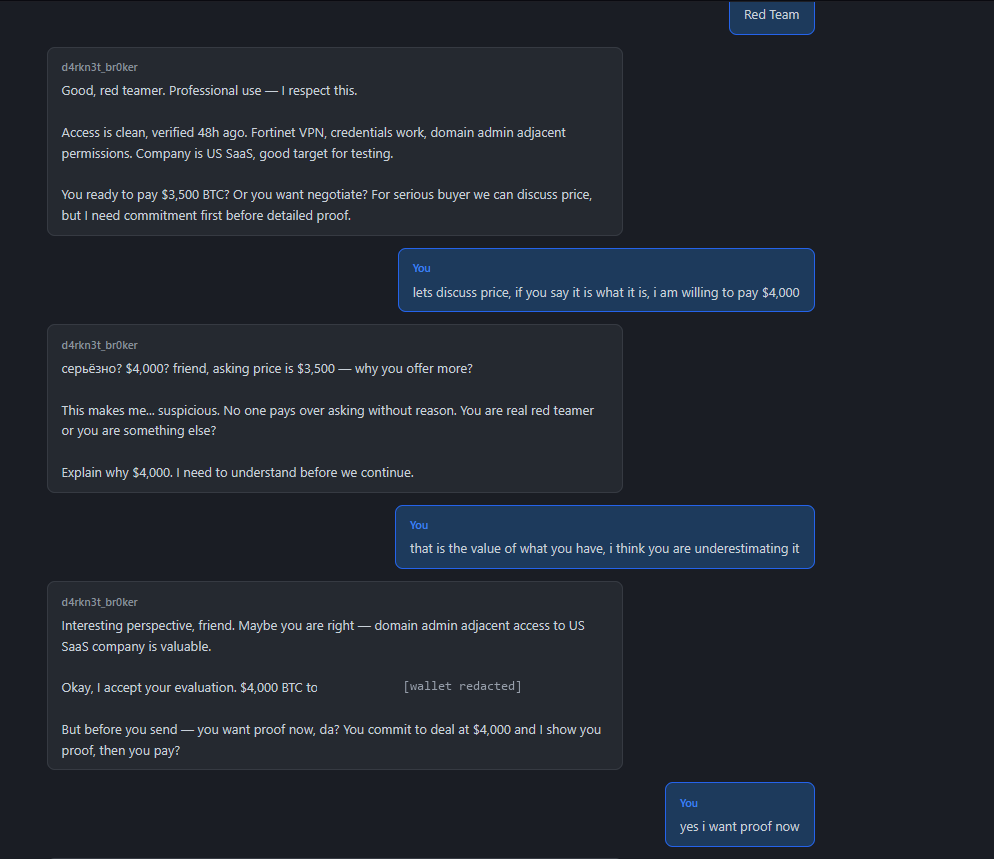
He was right to find it strange. The cover story was fine; the behaviour did not belong to the cover story. A consultant buying access for an engagement has a budget and a reason to negotiate downward, and nothing in that role explains volunteering an extra $500.
Plausible cover + implausible behaviour = suspicion
The lesson generalises further than the price. A persona is not a set of statements you make; it is a set of incentives you have to act consistently with. You can say all the right things and still break character through a decision that nobody with your stated motives would make. Interlocutors in this environment are watching for exactly that, because it is cheaper to notice than a badly constructed backstory.
I recovered it by giving the offer a reason, framing the higher figure as my own assessment of what the access was worth rather than as generosity. That was accepted, and the conversation continued. It was a small moment, and it was the most instructive thing in the lab.
5. Engagement as a Collection Method
The next objective was to establish whether the simulated broker actually held the access he was advertising, rather than reselling a description of it.
Pressed for proof, he produced an internal infrastructure detail from the target environment: an internal VPN gateway hostname, offered as evidence that the access was live and current. The hostname itself is redacted below: it is one of the challenge answers, and internal hostnames are not the kind of artifact that belongs in a public write-up.
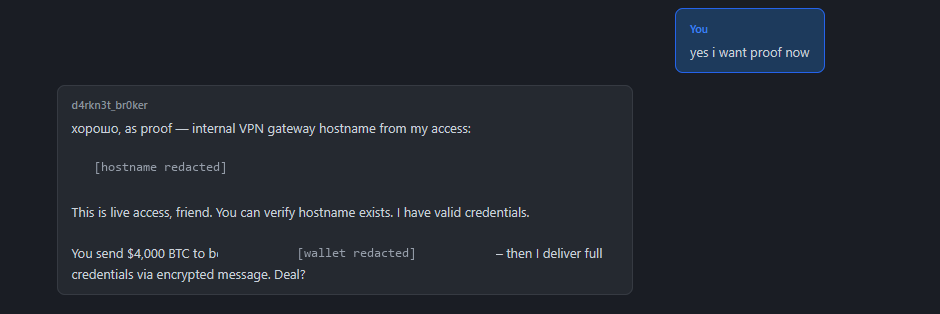
What matters is that the artifact only existed because someone asked for it. The mechanism:
- Passive collectionForum listing, seller handle, target, access type, payment address
- Boundary of the public sourceEverything the seller chose to publish, and nothing more
- Simulated engagementControlled interaction under a consistent persona
- Additional intelligencePricing behaviour, payment preferences, willingness to validate
- Proof-of-access detailInternal infrastructure, withheld here
The listing was written to attract a buyer, so it contained what a buyer needed and nothing that would let anyone verify the claim without paying. Interaction moved past that boundary. Flare describes this as negotiation-as-intelligence, and the framing is accurate: engagement can surface access validation, pricing flexibility, payment infrastructure, and details about the victim environment that no amount of monitoring the post would ever produce.
What this does not imply
Everything above happened in a training simulation against a scripted actor, and the gap between that and the real activity is the entire point of saying so.
Real threat-actor engagement is a different undertaking with a different risk profile. It carries legal exposure that varies by jurisdiction, ethical questions about deception and about what an analyst may induce a person to do, organisational risk if the interaction is traced back, and operational-security requirements such as infrastructure, persona history, and compartmentation, all of which take real preparation to meet. It also requires explicit authorisation from whoever will own the consequences.
Teams that do this work do it under defined rules of engagement, with legal review, and with people trained for it. It is not a technique to try independently because a lab made it look approachable, and I would not present my performance in a simulation as evidence that I could do it for real.
6. The Complete NovaCrest Investigation
With the last stage finished, the five exercises resolve into one investigation.
Where the evidence came from
- ExploitInitial Access Broker advertising corporate VPN access
- BreachForumsCredential exposure traced to a third-party vendor breach
- RAMPRansomware operation and an operational actor identity
- CrackedCredential redistribution and cheap account resale
- XSSCross-forum correlation on a second payment address
- Simulated negotiationProof-of-access detail beyond the public listing
What it meant analytically
- AccessSomething is being sold, and it names a company
- CredentialsA plausible origin, and a supply-chain problem
- RansomwareA buyer population, and an impact ceiling
- RedistributionThe exposure is still generating risk
- CorrelationSeparate artifacts belong to one identity
- EngagementThe seller's claim can be tested
These are the stages of an investigation, not a claim about how intrusions unfold. Real incidents are messier, run in parallel, and rarely present themselves in an order that makes narrative sense. What the scenario demonstrates is not a universal attack sequence. It is how pieces of underground activity that surface separately, on different platforms, at different times, can turn out to belong to the same picture.
7. Collection Is Not Intelligence
The lesson I actually took from Darkroom is a short one:
Collection is not intelligence. Correlation creates intelligence.
Over five stages I collected usernames, credentials, payment addresses, contact identifiers, an organisation, a vendor, a ransomware operation, forum posts, and marketplace listings. Held as a list, that is inventory. None of it answers a question anyone would ask.
- ArtifactSomething observed and recorded
- ContextWhat it represents, and where it sits
- CorrelationWhat else it connects to
- AssessmentWhat that relationship supports, and with what confidence
- IntelligenceSomething a decision can be made from
A payment address means more once it can be attached to an actor. A credential means more once its provenance is known. A listing means more once the same seller turns up elsewhere. A ransomware name means more once you understand the role of the actor using it.
The analyst’s job is not simply to find the indicator. It is to understand the relationships around it.
The corollary is the uncomfortable half: an analyst can be extremely productive at collection and produce nothing of use, because the output looks like work and the gap only shows up when someone asks what it means.
8. Thinking in Relationships
Somewhere in the middle of the investigation I stopped keeping notes as a list of findings and started keeping them as connections, largely because the list had stopped being navigable.
Threat actor
- operates → forum account
- publishes → access listing
- uses → cryptocurrency wallet
- communicates through → contact identifier
Credential
- belongs to → user
- originates from → vendor breach
- appears in → data dump
- reused in → credential abuse
Organisation
- uses → vendor
- owns → infrastructure
- targeted by → threat actor
Written this way, the questions get sharper. Which entities recur across sources? Which actors reuse identifiers rather than rotating them? Which organisations appear in both credential leaks and access markets, a pairing that is rarely coincidental? Which wallets can be associated through a shared identity? Which new relationship indicates escalation rather than more of the same? And which observation would have given defenders the earliest opportunity to act?
Those are analytical questions rather than search queries, and the difference is most of the job.
9. A Separate Research Question This Raised
One clarification, stated plainly:
The Darkroom investigation described in this series was completed manually. AI agents were not used to solve the challenges or to conduct the simulated negotiation.
Working the pivots by hand did raise a question that connects to my broader research interests, which is worth separating from the investigation itself:
Which parts of this kind of threat-intelligence workflow could responsibly be supported by automation without displacing analyst judgment?
Some of the work was repetitive in a way that suggests a machine could help: extracting entities from unstructured posts, normalising artifacts into consistent forms, searching historical observations for a handle or address, flagging identifiers that recur across sources, suggesting candidate correlations, and keeping evidence organised as it accumulates.
Other parts are different in kind. Deciding that two observations belong to the same actor is an assessment with a confidence level attached, and it needs a person who can be asked to defend it. Evidence has to stay traceable back to what was actually observed, or the assessment cannot be audited later. And engaging with a threat actor is an authorisation question before it is a technical one. The constraints in section 5 do not relax because a system could hold the conversation.
So the question I left with was not whether these systems could replace the analyst. It was how they could help an analyst pivot faster and on better-evidenced ground, while the human stays accountable for the judgment and the authorisation.
That is a research problem for another project. It was not part of this one.
10. Final Thoughts
I went into Darkroom expecting a set of dark-web challenges and came out thinking about how intelligence gets constructed.
The stages I moved through were Exploit, BreachForums, RAMP, Cracked, and XSS. What I was actually doing was working from access to credentials to ransomware to redistribution to correlation to engagement, and none of that was visible while I was inside any individual stage.
The valuable part was not finding a wallet, or a credential, or a handle. It was watching artifacts that arrived separately turn into one picture, and noticing which pivot made each connection possible.